
An upcoming M.Tech dissertation review can feel stressful, especially when your supervisor or review committee expects you to explain months of work within a few minutes. The good news is that a dissertation review is usually not about presenting a perfect finished project. It is about demonstrating that you understand your research problem, have followed a logical methodology, and are making measurable progress toward your objectives.
Whether you are preparing for your first progress review, pre-submission review, or final dissertation defense, good preparation can make a significant difference.
Need Help ? Contact us – support@liftmypaper.in
1. Start With a Clear Research Problem
One of the first things the review panel may want to understand is surprisingly simple:
What problem are you actually solving?
You should be able to explain your research problem in two or three sentences without reading directly from your dissertation.
Your explanation should cover:
- What problem exists?
- Why is it important?
- What limitation exists in current approaches?
- What are you proposing to investigate or improve?
Avoid beginning your presentation with several slides of generic background information. Move toward the actual research problem quickly.
For example, instead of saying:
“Machine learning is becoming increasingly popular in engineering applications…”
a stronger research-oriented statement might be:
“Existing prediction models for this application show reduced accuracy under changing operating conditions. This work investigates whether a modified machine-learning framework can improve prediction performance while maintaining computational efficiency.”
The second version immediately tells the committee what your research is about.
2. Be Ready to Explain the Research Gap
A literature review should do more than show that you have read research papers.
Your reviewers may ask:
“What is missing in the existing literature?”
Your dissertation should clearly establish the connection:
Existing research → Limitation → Research gap → Your proposed work
Prepare three to five important papers that are closely related to your research. You do not need to memorize dozens of references, but you should understand the studies that directly influenced your methodology.
A simple comparison table can be extremely useful:
| Existing Study | Method Used | Main Result | Limitation | Your Improvement |
|---|---|---|---|---|
| Study 1 | Method A | Good accuracy | Small dataset | Larger dataset |
| Study 2 | Method B | Fast prediction | Lower accuracy | Optimized model |
| Study 3 | Simulation approach | Good numerical results | Limited validation | Additional validation |
This makes your research gap much easier to defend.
3. Check Your Research Objectives Carefully
Your objectives are among the most important parts of the dissertation.
Before the review, compare every objective written in your dissertation with the work you have actually completed.
Ask yourself:
Objective 1: Have I completed it?
Objective 2: Where are the corresponding results?
Objective 3: What evidence demonstrates that it has been achieved?
If an objective appears in your dissertation but there is no methodology or result connected to it, reviewers are likely to notice.
A good dissertation should show a logical flow:
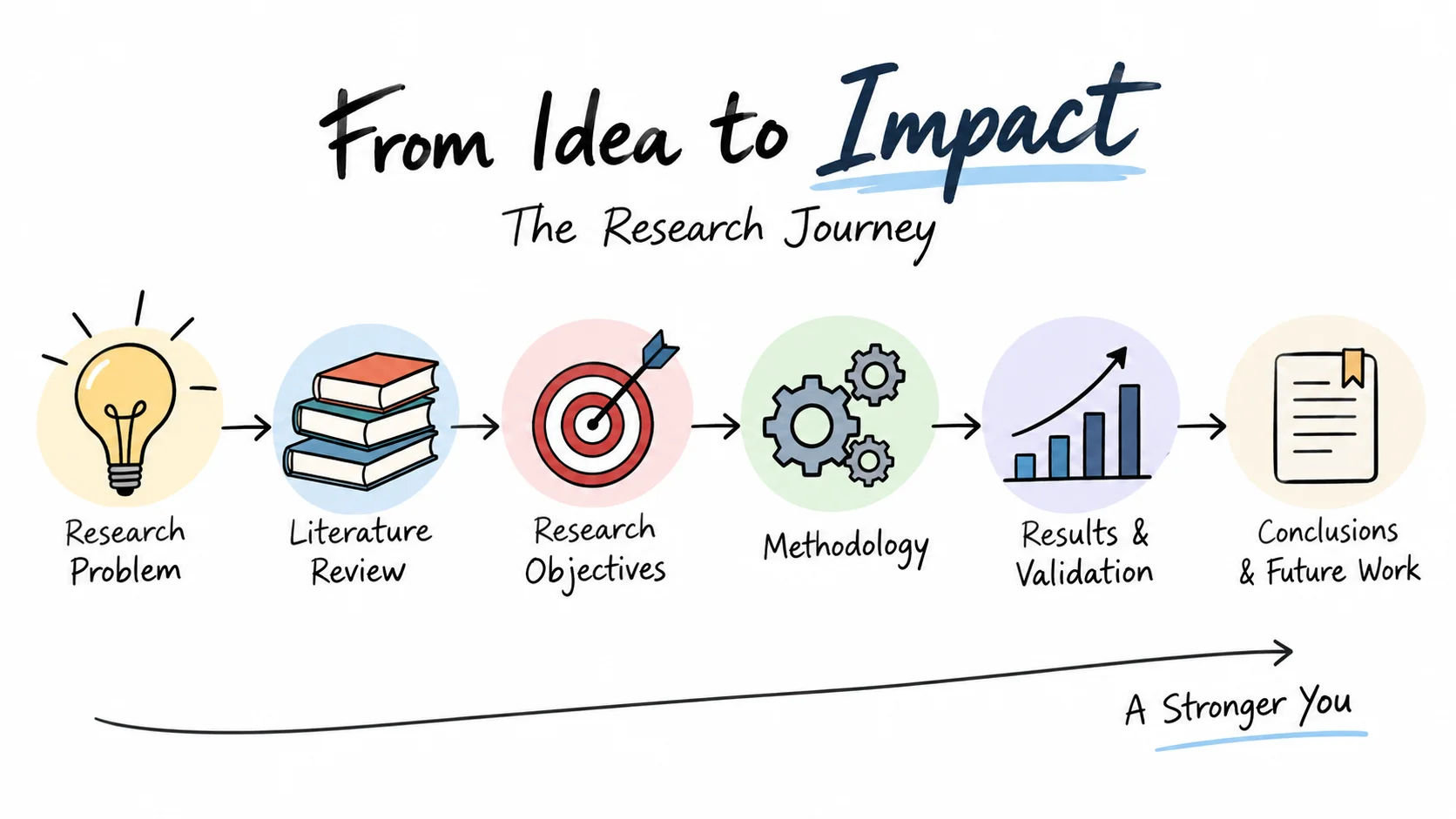
Problem → Objectives → Methodology → Results → Conclusions
Each major result should connect to at least one research objective.
4. Prepare a Clear Methodology Workflow
Your methodology is not just a chapter in your dissertation. During the review, you must demonstrate that you understand every important decision involved.
Prepare a simple workflow diagram showing the complete process.
For example:
Problem Definition → Data Collection → Preprocessing → Model Development → Testing → Validation → Performance Analysis
For simulation-based research:
Geometry → Material Properties → Physics Selection → Boundary Conditions → Meshing → Solver → Results → Validation
For experimental research:
Sample Preparation → Experimental Setup → Measurement → Data Processing → Analysis → Validation
Your reviewers may ask why you selected a particular algorithm, simulation method, parameter, dataset, boundary condition, statistical test, or optimization technique.
Do not only know what you used.
Know why you used it.
5. Verify Your Results Before Making the PPT
Students sometimes create attractive presentation slides before carefully checking their results.
Do the opposite.
First verify:
- Units
- Axis labels
- Figure captions
- Table values
- Percentage calculations
- Error values
- Performance metrics
- Significant digits
- Repeated experiments or simulations
- Consistency between dissertation and presentation
If your dissertation says the model achieved 94.6% accuracy while your presentation says 96.4%, even a simple typing error can create unnecessary questions during the review.
6. Don’t Just Show Results. Interpret Them.
A common weakness in M.Tech dissertations is presenting several graphs followed by statements such as:
“It can be observed that the value increases.”
That describes the graph, but it does not explain the research.
For every major result, prepare answers to three questions:
What happened?
Why did it happen?
Why does it matter?
Suppose parameter X increases and efficiency decreases.
Instead of simply saying:
“Efficiency decreases with increasing X.”
explain the mechanism:
“Increasing X produces a higher loss within the system, which reduces the effective output and therefore lowers the overall efficiency.”
The exact explanation will depend on your research field, but the principle remains the same.
Your discussion should explain the reason behind the result, not merely repeat what the graph already shows.
7. Prepare Evidence of Validation
One question frequently asked during technical reviews is:
“How did you validate your results?”
Validation can take different forms depending on your project:
- Comparison with published literature
- Comparison with experimental results
- Benchmark dataset
- Analytical solution
- Existing standard model
- Experimental measurements
- Cross-validation
- Error analysis
- Sensitivity analysis
- Comparison with alternative algorithms
- Mesh-independence or convergence study
Without proper validation, even impressive results may be difficult to defend.
If direct experimental validation is not possible, clearly explain the alternative validation strategy you have used.
8. Know Your Figures, Tables, and Equations
Anything that appears in your presentation is fair game for questions.
If you include an equation, know:
- What the variables represent
- Why the equation is required
- What assumptions it makes
- Where it is used in your work
If you include a graph, understand:
- X-axis
- Y-axis
- Units
- Trend
- Important peaks or changes
- Reason behind the behavior
If you include a table, know why those particular values are being compared.
Do not include complicated equations or diagrams merely because they make the presentation look technical.
Every slide should serve a purpose.
9. Prepare Your Dissertation PPT Carefully
A typical M.Tech dissertation review presentation can follow this sequence:
- Title and research information
- Background
- Problem statement
- Literature review
- Research gap
- Objectives
- Proposed methodology
- System/model architecture
- Implementation or experimental setup
- Results
- Validation
- Comparative analysis
- Major findings
- Limitations
- Future scope
- Publications, if applicable
- Conclusion
The exact structure may vary according to university guidelines.
Keep slides visual whenever possible. A workflow diagram, architecture diagram, result graph, or comparison table usually communicates more effectively than a paragraph containing ten lines of text.
10. Prepare for the Most Likely Viva Questions
You cannot predict every question, but many dissertation reviews revolve around a common set of themes.
Be prepared to answer questions such as:
- Why did you choose this topic?
- What exactly is novel in your work?
- What research gap did you identify?
- Why did you select this methodology?
- Why did you use this algorithm or software?
- What dataset did you use?
- How did you select the parameters?
- How did you validate your model?
- What are the limitations of your approach?
- How does your method compare with existing studies?
- What is your most important result?
- Can your methodology be applied to another problem?
- What would you improve if you continued this research?
- What part of the work did you personally implement?
- Can this work lead to a research publication?
Prepare concise answers rather than memorizing long responses.
11. Check Your References
References often receive less attention during presentation preparation, but errors here can create problems during dissertation evaluation.
Check for:
- Missing references
- Duplicate references
- Incorrect author names
- Inconsistent citation styles
- References cited in text but missing from the bibliography
- Bibliography entries never cited in the dissertation
- Incorrect DOI information
- Incomplete journal details
Reference-management tools such as Zotero or Mendeley can help, but automatically generated references should still be manually checked.
12. Prepare Your Dissertation File Before the Review
Do not leave document formatting until the final night.
Check:
- Table of contents
- List of figures
- List of tables
- Chapter numbering
- Figure numbering
- Equation numbering
- Page numbering
- Margins
- Font consistency
- Heading hierarchy
- Captions
- Abbreviations
- References
- University formatting requirements
Also ensure that your dissertation title, objectives, methodology, results, and conclusion are consistent throughout the document.
13. Keep Backup Files Ready
Technical problems during a presentation are more common than most students expect.
Keep:
- PPT file
- PDF version of the presentation
- Dissertation PDF
- Important result files
- Important datasets
- Important figures
- Source code or simulation files, if relevant
Store them on your laptop as well as in cloud storage or another backup location.
If your project involves software, simulation, or machine learning, keeping screenshots of major outputs is also useful in case the software fails during the demonstration.
14. Practice Explaining Your Research Without the Slides
This is one of the most useful preparation exercises.
Try explaining your entire research in approximately three minutes without looking at your presentation.
You should be able to explain:
The problem → The gap → What you did → What you found → Why it matters
If you can explain those five elements clearly, you already understand the backbone of your dissertation.
Then practice a longer version using your presentation.
15. Do a Mock Dissertation Review
A mock review can reveal weaknesses that are difficult to notice while repeatedly reading your own dissertation.
Ask a friend, senior researcher, supervisor, or someone familiar with your field to question you about:
- Methodology
- Research gap
- Results
- Validation
- Novelty
- Limitations
Questions that initially feel uncomfortable are often the most useful because they expose areas that need additional preparation.
Your Final M.Tech Dissertation Review Checklist
Before walking into the review, make sure you have:
- Final or updated dissertation document
- Presentation slides
- Clearly defined research problem
- Research gap
- Final research objectives
- Methodology workflow
- Major results
- Result interpretation
- Validation evidence
- Comparison with previous research
- Conclusions
- Limitations
- Future scope
- Correct references
- Backup presentation and dissertation files
- Answers to likely viva questions
Most importantly, understand your own work rather than trying to memorize the dissertation.
Final Thoughts
An M.Tech dissertation review is not simply a test of how attractive your presentation looks. The review committee wants to see whether you understand the research problem, can justify your methodology, interpret your results correctly, and defend the conclusions you have drawn.
Start preparing early. Review your dissertation carefully, connect every objective with appropriate results, verify important figures and calculations, and practice explaining your work in simple language.
If your dissertation involves AI/ML, data analysis, numerical modelling, simulation, computational research, or other software-based projects, additional preparation may also be required for methodology validation, implementation, result analysis, project documentation, presentation preparation, and viva questions.
The stronger your understanding of the logic behind your project, the easier your dissertation review becomes.
Need Help ? Contact us – support@liftmypaper.in
Liftmypaper