
Choosing an M.Tech project topic is one of the most important decisions you will make during your postgraduate degree. A good project can help you complete your dissertation smoothly, build practical technical skills, produce a conference or journal paper, and even strengthen your profile for PhD admissions or industry jobs.
A poor topic can do exactly the opposite. Many students select a topic because it sounds advanced, because a senior worked on something similar, or because they found an attractive title online. A few months later, they discover that the required dataset is unavailable, the simulation is too computationally expensive, the problem has already been studied extensively, or the project cannot produce meaningful results.
In 2026, choosing a project topic requires more than simply selecting a trending technology. The best M.Tech project lies at the intersection of research relevance, technical feasibility, available resources, your specialization, and a clearly defined problem.
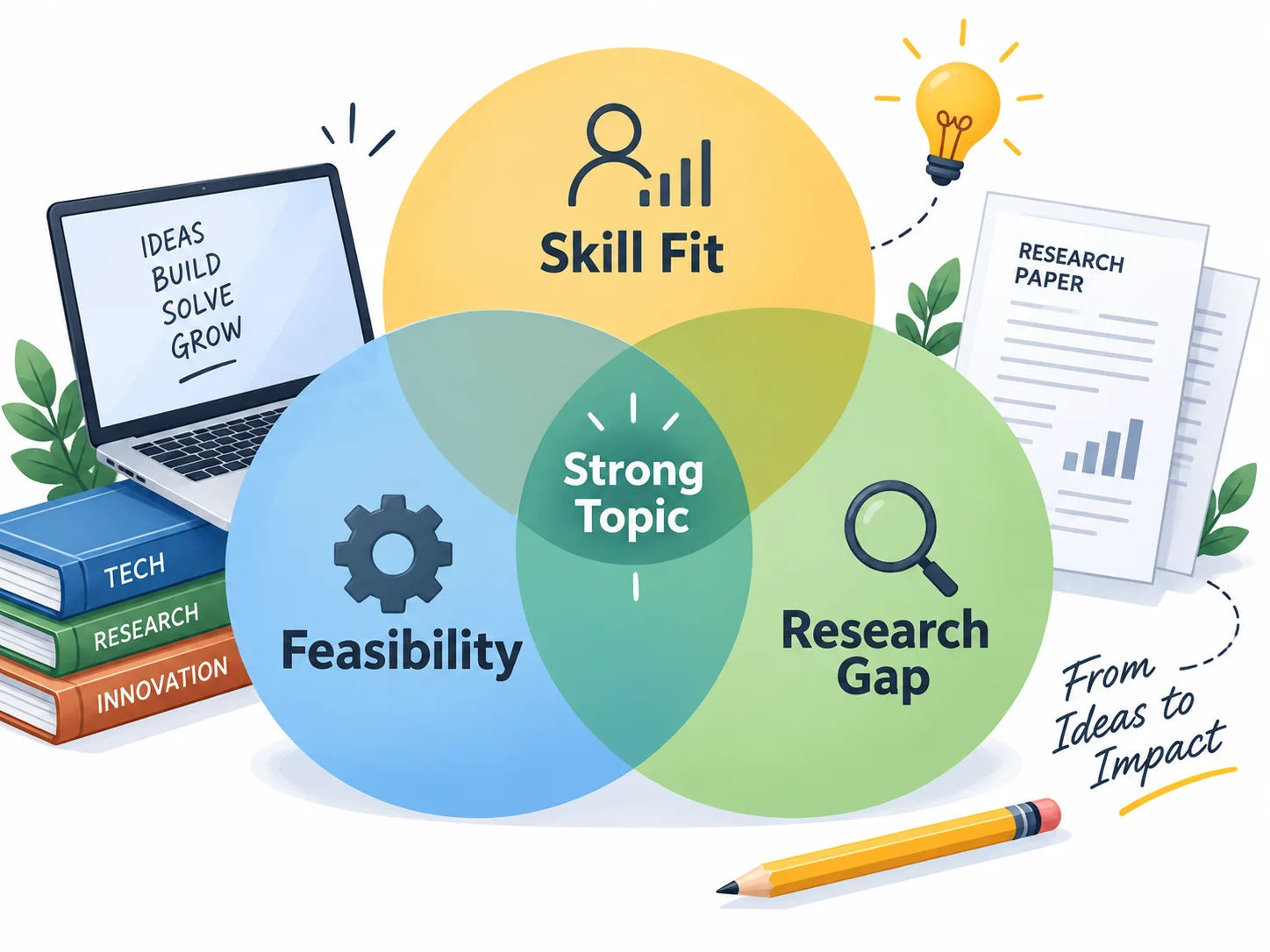
What Makes a Good M.Tech Project Topic?
A good project topic should answer four basic questions:
Is there a real problem to solve?
Your project should address a specific limitation, research gap, optimization problem, prediction problem, design challenge, or practical engineering requirement.
Can you actually complete it?
A technically impressive topic is useless if it requires equipment, data, computational resources, software expertise, or experimental facilities that you cannot access.
Can you measure the outcome?
A strong engineering project needs measurable results. Depending on the field, these could include accuracy, sensitivity, efficiency, computational time, energy consumption, temperature, stress, displacement, bandwidth, loss, signal-to-noise ratio, cost, or another relevant performance parameter.
Can you explain what is new?
Novelty does not necessarily mean inventing an entirely new technology. An M.Tech project can make a useful contribution by improving an existing method, comparing techniques, applying a known approach to a new problem, optimizing parameters, integrating two methods, or validating a computational model.
Do Not Start With a Project Title
One of the most common mistakes students make is searching Google for phrases such as:
“Latest M.Tech project topics in AI”
or:
“Best MATLAB project title for M.Tech”
This often produces attractive titles without a clear research problem.
Instead, start with a problem area.
For example, instead of beginning with:
“Machine Learning-Based Battery Management System”
start with the problem:
Can battery state-of-health be predicted accurately using a smaller number of sensor parameters?
Now you have something that can be investigated.
From this question, the project can evolve into a more specific topic such as:
Machine Learning-Based State-of-Health Estimation of Lithium-Ion Batteries Using Reduced Sensor Features
The second approach is much stronger because the title emerges from the research problem.
Need help refining your M.Tech project idea?
At LiftMyPaper.in, we help students turn broad ideas into focused, feasible research projects. This can include topic refinement, research-gap identification, methodology planning, simulation or software-based implementation guidance, data analysis, and publication-oriented project planning.
Step 1: Choose the Right Broad Domain
First identify two or three areas that genuinely match your M.Tech specialization.
For a Computer Science student, these might include:
- Artificial intelligence and machine learning
- Cybersecurity
- Computer vision
- Natural language processing
- Cloud and distributed computing
- Internet of Things
- Data analytics
For Mechanical, Civil, Electrical, Electronics, Materials, Energy, or related engineering disciplines, suitable directions could include:
- Finite element modelling
- Computational fluid dynamics
- Multiphysics simulation
- Digital twins
- Structural optimization
- Renewable energy systems
- Battery modelling
- Thermal management
- Smart materials
- Sensors
- Control and optimization
- Predictive maintenance
The important point is not to choose a technology simply because it is popular. Choose an area in which you can realistically build sufficient technical depth.
Step 2: Look at What Is Actually Relevant in 2026
Technology trends can help you identify promising directions, but they should be used as inspiration rather than copied directly into a project title.
For example, Gartner’s 2026 technology outlook highlights areas including AI-native development, domain-specific AI models, multi-agent systems, physical AI, confidential computing, AI security and preemptive cybersecurity. (Gartner)
Digital twins are also increasingly being connected with physical AI, where simulation environments can be used not only for visualization but also for modelling and training intelligent physical systems. (Gartner)
This creates interesting M.Tech-level research directions such as:
AI + Mechanical Engineering:
Predicting component failure using simulation-generated data.
AI + Electrical Engineering:
Machine-learning-based fault classification in power systems.
AI + Civil Engineering:
Prediction of structural response using surrogate models.
Simulation + Electronics:
Thermal optimization of electronic packages.
Cybersecurity + AI:
Detection of abnormal network behaviour using explainable machine learning.
Digital Twin + Energy:
Digital twin of a photovoltaic, battery, motor, or thermal system.
AI + Computational Engineering:
Replacing computationally expensive simulations with trained surrogate models.
Notice that these are combinations of a technical problem and a modern methodology, not simply fashionable keywords.
Step 3: Read Recent Research Papers Before Finalizing the Topic
Before selecting your project, search recent papers published between roughly 2023 and 2026.
Google Scholar, Scopus, Web of Science, IEEE Xplore, ScienceDirect, SpringerLink and other academic databases can help.
Do not try to read fifty papers completely. Start with approximately 10 to 20 highly relevant papers and examine:
What problem did they solve?
What methodology did they use?
What parameters did they investigate?
What limitations did the authors mention?
What future work did they suggest?
The last two questions are especially valuable.
Suppose five recent papers use deep learning for fault detection but most require very large training datasets. That limitation could lead to a project investigating:
Fault Diagnosis Using Transfer Learning for Limited Industrial Training Data
The research gap has now naturally created your project.
Step 4: Check Whether the Project Is Feasible
Before becoming attached to a topic, perform a feasibility check.
Ask yourself:
| Question | Why it matters |
|---|---|
| Do I have the required data? | Many AI projects fail because suitable datasets cannot be obtained. |
| Do I have the required software? | Specialized simulation or analysis may require software access. |
| Do I need laboratory equipment? | Experimental projects depend heavily on facility availability. |
| Can my computer handle the calculations? | Large ML models and 3D simulations can require substantial resources. |
| Can I learn the required method? | Avoid choosing a project containing five unfamiliar technologies. |
| Can it be finished within my M.Tech timeline? | Scope is more important than an impressive title. |
| Can I generate enough results? | Results are necessary for the dissertation and possible publication. |
A smaller project completed properly is usually much stronger than an extremely ambitious project that remains unfinished.
Step 5: Define the Research Gap
Students often assume that a research gap must mean that nobody in the world has ever studied the subject.
That is rarely necessary.
Your gap could be:
Performance gap: Existing accuracy or efficiency is inadequate.
Methodological gap: A different algorithm or modelling method has not been investigated properly.
Comparison gap: Several available approaches have not been systematically compared.
Optimization gap: Important parameters have not been optimized.
Application gap: An existing method has not been tested for a particular application.
Integration gap: Two established approaches have not been combined.
Validation gap: Numerical predictions lack experimental or benchmark validation.
Computational gap: Existing models require excessive computational resources.
Once you can express your gap in one or two sentences, choosing the project title becomes much easier.
Step 6: Avoid Projects That Are Too Broad
Consider this title:
“Artificial Intelligence in Renewable Energy”
This is not really an M.Tech project. It is an entire research field.
A better topic would be:
“Short-Term Solar Power Forecasting Using an LSTM-Based Prediction Model”
Better still, after reviewing the literature, you might refine it to:
“Comparative Analysis of LSTM and Transformer Models for Short-Term Solar Power Forecasting Under Variable Weather Conditions”
Now the objective, methods and comparison are much clearer.
The same principle applies to simulation projects.
Too broad:
Finite Element Analysis of Composite Materials
Better:
Finite Element Investigation of Stress Concentration in Laminated Composite Plates
More research-oriented:
Parametric Optimization of Ply Orientation for Reducing Stress Concentration in Laminated Composite Plates Using Finite Element Modelling
Each refinement converts a broad subject into a manageable research problem.
Step 7: Make Sure the Topic Can Produce Results
Before approving a topic, imagine the final Results section of your dissertation.
What graphs will you show?
What variables will you compare?
What tables will you generate?
What exactly will improve?
For example, imagine a project involving the thermal management of a battery pack.
Possible outputs could include:
- Temperature distribution
- Maximum cell temperature
- Temperature difference between cells
- Cooling-channel velocity
- Coolant flow rate
- Heat-transfer coefficient
- Pressure drop
- Cooling-system energy consumption
You can already imagine several graphs and comparisons.
That is usually a good sign.
If you cannot imagine what results the project will generate, the topic probably requires further refinement.
Step 8: Do Not Add AI Just to Make the Title Look Modern
One particularly common problem in 2026 is unnecessarily adding “AI”, “deep learning”, “generative AI” or similar terms to ordinary engineering projects.
AI should solve a problem.
For example:
Weak concept:
AI-Based Finite Element Analysis of a Heat Exchanger
What exactly is AI doing?
A more meaningful project could be:
Machine Learning Surrogate Model for Rapid Prediction of Heat Exchanger Performance Using CFD-Generated Training Data
Here the workflow has a clear purpose:
Simulation → Dataset Generation → Machine Learning → Prediction → Validation
The machine-learning model reduces the need to repeatedly perform expensive simulations.
That is a defensible research methodology.
Step 9: Think About Publication Potential
You do not necessarily need to publish your M.Tech project. However, selecting a topic with publication potential usually improves the quality of the dissertation itself.
A project becomes more publishable when it contains:
A clearly defined gap + appropriate methodology + systematic experiments/simulations + comparison + validation + meaningful discussion
For example, simply training a CNN model on a publicly available dataset may be enough for a classroom exercise but may provide little research contribution.
Adding an appropriate research question could change the situation:
How does model performance change under class imbalance?
Can explainable AI identify the features responsible for classification?
Can a lightweight model achieve similar accuracy with lower computational cost?
Does transfer learning work when training data are limited?
Now there is something to investigate rather than merely implement.
A Simple Formula for Selecting Your M.Tech Topic
A useful way to construct a research topic is:
Problem + Method + Application + Improvement
For example:
Problem: Early fault detection
Method: Machine learning
Application: Induction motor
Improvement: Limited sensor data
Possible topic:
Machine Learning-Based Early Fault Detection in Induction Motors Using Reduced Sensor Features
Another example:
Problem: Excessive device temperature
Method: Multiphysics modelling and optimization
Application: Battery module
Improvement: Improved thermal uniformity
Possible topic:
Simulation-Based Optimization of Battery Module Cooling for Improved Thermal Uniformity
This approach is far more reliable than randomly choosing project titles from online lists.
A 7-Point Test Before Finalizing Your Topic
Give your proposed project one point for each “Yes”.
- Does it solve a clearly identifiable problem?
- Can I explain the research gap?
- Are the required data, software and resources available?
- Can it realistically be completed within my degree timeline?
- Will it produce measurable results?
- Can I compare my results with an existing method or benchmark?
- Is there enough novelty or analysis for a dissertation and possibly a publication?
A topic scoring 6 or 7 is usually worth serious consideration.
A topic scoring 3 or 4 probably needs refinement.
If you cannot answer even the first few questions clearly, do not start implementation yet.
Examples of Promising M.Tech Project Directions for 2026
Depending on your specialization, interesting directions include:
- Physics-informed machine learning for engineering problems
- Simulation-driven machine learning
- Digital twins for engineering systems
- Predictive maintenance
- Explainable AI for engineering applications
- Lightweight AI models for edge devices
- AI-assisted optimization
- Battery modelling and thermal management
- Renewable-energy forecasting
- Electric-vehicle system modelling
- Smart-grid optimization
- Computational materials engineering
- Structural health monitoring
- CFD-based design optimization
- Finite element modelling of advanced materials
- Cybersecurity for AI-enabled systems
- AI-based anomaly detection
- Privacy-preserving and secure computing
- Sensor-data analytics
- Surrogate modelling for computationally expensive simulations
- Multi-objective engineering optimization
The best choice still depends on your branch, facilities, available software, supervisor expertise and the amount of time remaining.
Final Advice
Do not ask:
“What is the most trending M.Tech project topic in 2026?”
Ask:
“What meaningful problem can I realistically solve using the skills and resources available to me?”
That small change in thinking can completely change the quality of your project.
A strong M.Tech project does not require the longest title, the newest buzzword, or an unnecessarily complicated model. It requires a clear problem, a defensible research gap, a feasible methodology, measurable results and enough technical depth to demonstrate what you have learned.
Choose the problem first. Select the methodology second. Decide the title last.
That is one of the safest ways to build an M.Tech project that can become not only a successful dissertation, but potentially a strong research paper, portfolio project, PhD starting point, or demonstration of your technical capability.
Need Help Selecting or Refining an M.Tech Project Topic?
If you already have a broad project idea but are unsure about the research gap, methodology, simulation or computational approach, implementation plan, results strategy, dissertation structure, or publication potential, you can discuss the project with the research team at LiftMyPaper.in.
The objective should not be to simply obtain a project title. It should be to convert your idea into a clear, feasible and academically meaningful research problem.
Still confused about your project topic?
Share your specialization and broad area of interest with us at LiftMyPaper.in. We can help you refine the idea, identify a realistic research gap, and plan a project that is technically feasible and research-oriented.
Need Help ? Contact us – support@liftmypaper.in
Liftmypaper